Inspection Station Tracking: Stop Hidden Queue Delays
Inspection Station Tracking: How CNC Shops Stop Hidden Queue Delays
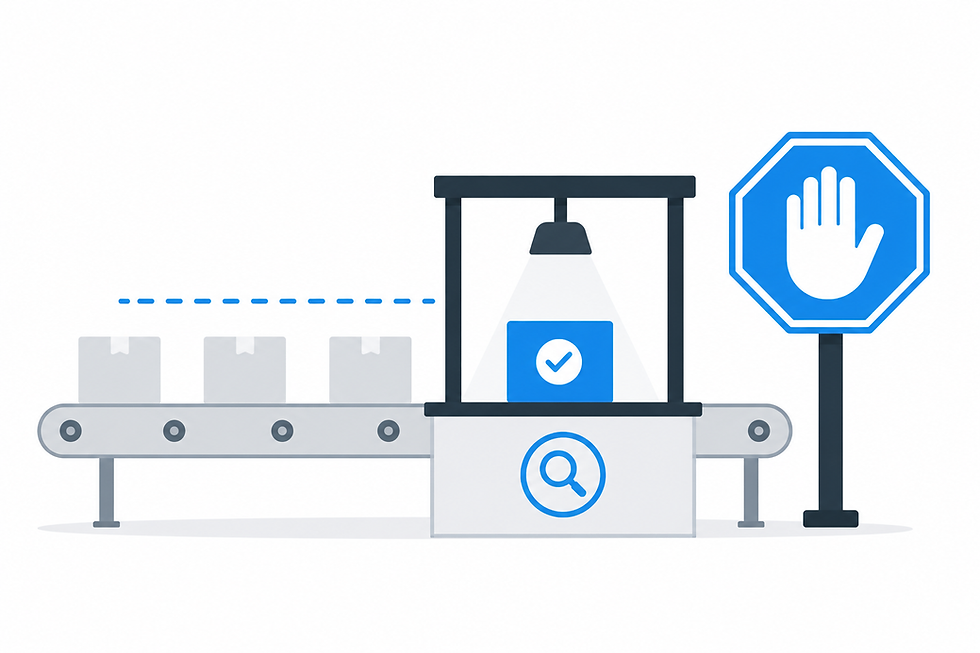
If your machines are running and you’re still missing ship dates, the constraint is often hiding in plain sight: inspection. Not because inspection “takes too long,” but because time disappears between machining complete and inspection start—parts waiting on a cart, a CMM schedule no one can see, or a hold that isn’t visible until the next shift is already behind.
Inspection station tracking isn’t about building better reports. It’s lightweight event capture that gives you same-shift answers to flow questions: what’s waiting, why it’s waiting, how long it’s been there, and what gets released next.
TL;DR — Inspection Station Tracking
Most inspection delays come from queue time, unclear priorities, or missing prerequisites—not touch time.
Track a small set of events (arrived, started, completed, held, released) to expose the handoff gap.
Separate queue time vs touch time so you fix the right problem (staffing/priorities vs methods).
Standardized hold reasons turn “waiting” into actionable categories (program, gauges, certs, drawing questions, rework).
Queue age by station is the fastest multi-shift handoff signal—no more morning surprises.
Re-inspection loops consume capacity silently; track re-entry counts and causes by job/part.
Implementation should reach “first signal” in days, with minimal operator burden and consistent timestamps.
Key takeaway Inspection is often the throughput limiter because the biggest losses happen in handoffs: machine-complete to inspection-start, hold time, and re-inspection loops. When those timestamps and reasons are visible in real time (by shift and by station), you can recover capacity before adding equipment or expediting—by changing priority rules, prerequisites, and staffing windows.
Why inspection becomes a hidden throughput constraint
Inspection has the classic conditions of a bottleneck even in well-run CNC job shops: shared resources (a limited number of inspectors, a single CMM, a couple of surface plates, critical gauges) and variable cycle time (FAI vs in-process vs final, easy dimensions vs complex GD&T). Machines can look busy while throughput is being throttled downstream.
The biggest delays usually aren’t “inspection time.” They’re waiting, prioritization confusion, and missing information or tooling: the CMM program isn’t ready, the print revision is unclear, certs aren’t with the lot, or the correct gauge set is somewhere else. Without a disciplined way to timestamp those moments, that lost time gets misattributed to machining, “operator pace,” or the schedule itself.
This is where utilization leakage shows up: machining completes, the ERP traveler says the op is done, but the next operation doesn’t start because inspection never actually began. That gap—machine-complete to inspection-start—can become a repeatable delay pattern that hides between departments.
Multi-shift operations amplify the damage. If second shift finishes high-priority machining and the parts sit at inspection because the CMM is booked for FAIs, the morning shift often discovers it too late. The result is a next-shift fire drill: overtime, premium freight, or a rushed priority reshuffle that disrupts the whole cell. Real-time visibility into inspection queues and holds is what prevents the surprise.
Define inspection station tracking (what to track and why)
Inspection station tracking is the practice of treating inspection as a measurable station with defined states and events—captured as they happen—so you can manage flow in the current shift. It’s not a quality documentation project and it’s not a generic “dashboard.” It’s a short list of enforceable timestamps that explain where WIP is stuck and why.
At minimum, track inspection as states + events:
Arrived / queued at inspection
Started inspection
Completed inspection
Held (with a standardized reason)
Released to next operation (deburr, wash, assembly, shipping, rework)
A minimum viable data model keeps it practical and consistent: job/part, operation, quantity or lot, station, inspector (or team), timestamp, hold reason. If you already do manual operations tracking at other shared stations (deburr, wash, assembly), inspection fits the same event-based approach—just with more emphasis on holds and re-entry.
Two time buckets must be separated because they drive different fixes:
Queue time: arrived to started. This points to prioritization, staffing windows, batching behavior, missing prerequisites, or station routing issues.
Touch time: started to completed. This points to method, program readiness, measurement strategy, and training—still important, but not the first lever when on-time delivery is slipping.
Finally, capture inspection type so priority rules are possible without spreadsheet triage: FAI, in-process, final, audit/spot-check. A CMM queue made up of FAIs behaves differently than a final inspection backlog, and treating them as one bucket is how hot jobs get buried.
The 8 signals that reduce delays immediately
Once those basic events are reliable, you can generate a set of operational signals that support same-shift decisions. The goal is simple: remove ambiguity around what is waiting, what is blocked, and what should be worked next.
1) Queue length and age by station
“How many lots are waiting at CMM-1 right now, and what’s the oldest?” Queue age is the clearest handoff artifact across shifts. It tells you if inspection is quietly becoming the day’s constraint before the schedule collapses.
2) Top hold reasons
Hold categories turn delays into fixable work: missing certs, missing gauges, program unavailable, drawing ambiguity, rework needed, awaiting disposition, awaiting calibration verification. This is the inspection equivalent of structured machine downtime tracking—you’re classifying stoppages so you can remove them, not just recording that “it stopped.”
3) Re-inspection loops per job/part
If a part fails inspection, goes to rework, and returns multiple times, it consumes inspection capacity again and again while the shop still reports machining “on-time.” Counting re-entry events (and their reasons) is how you expose hidden capacity consumption that directly impacts ship dates.
4) Arrival rate vs completion rate by hour/shift
When arrivals outpace completions for a sustained period, the backlog is mathematically guaranteed to grow. You don’t need heavy analytics—just enough to see when inspection is falling behind so you can adjust staffing windows or routing before the queue age becomes tomorrow’s problem.
5) Downstream starvation risk
Look for jobs that are cleared from machining but blocked at inspection. That’s the handoff gap that makes the schedule lie. This is where capacity recovery often happens before you consider adding another machine or expanding floor space.
6) Priority exceptions
A short list of “hot jobs waiting in inspection” prevents low-impact work from clogging the CMM or bench station. The point isn’t to constantly expedite—it’s to enforce consistent priority rules with visibility, not hallway conversations.
7) Inspector workload distribution (capacity balancing)
Tracking who is working what helps you balance capacity across stations and shifts. Done correctly, it’s not performance management—it’s a way to avoid one inspector being overloaded with FAIs while another is stuck waiting on prerequisites.
8) CMM vs bench inspection split
Separate queues for CMM and bench work so the CMM backlog doesn’t mask available bench capacity. This separation is also a practical way to avoid inspection turning into a single undifferentiated “quality” bucket.
If you already use machine utilization tracking software for spindle-side visibility, these inspection signals complement it by covering the manual constraint that often throttles shipping even when machine utilization looks fine.
How to implement inspection tracking without slowing the floor
Implementation succeeds or fails on two things: minimizing data friction and keeping timestamps trustworthy. If tracking adds steps or creates arguments about definitions, people will route around it and you’ll be back to end-of-shift guesses.
Start with 3–5 events max
Begin with arrived/queued, started, completed, held, released. Don’t expand until behavior stabilizes. Early success is “we can see the queue age and the top holds today,” not “we captured every dimension of every report.”
Use unambiguous station definitions
Define stations the way people physically work: CMM-1, CMM-2, Bench-1, Receiving Inspection, Final Packout Check. “Inspection” as one station causes muddy check-ins and destroys the queue signal.
Capture at the point of work
Use a scan or quick input at arrival/start/complete/hold with predefined reasons. The closer the capture is to the moment the work changes state, the more reliable the queue and hold signals become—especially across shifts.
Standardize hold reasons (8–12 options)
Avoid free-text as the primary input. A controlled list makes the data usable for decisions. Free-text can be optional for context, but the main hold category should be consistent so you can see patterns without debate.
Add a “missing prerequisites” checklist
A short checklist prevents predictable holds: program ready, gauges staged, print revision confirmed, certs present, fixture identified, route clarified (CMM vs bench). This is often faster than buying capacity because it reduces avoidable stops before they become queue age.
Multi-shift handoff discipline
Require a visible WIP “age” field and a short note for holds older than a set threshold (many shops start with something like 8–24 hours depending on takt and mix). The point is accountability without punishment: the next shift should instantly see what’s blocked and what to do next.
If your inspection work is mixed with other shop-floor tracking, ensure inspection is not forced into an equipment-centric model. Inspection is a manual/shared-resource station, and the system needs to be comfortable with that. (This is one reason many shops explore broader machine monitoring systems but still need a clean method for manual constraints like inspection.)
Scenario walk-throughs: what changes when inspection is tracked in real time
The value of inspection station tracking shows up when you can change decisions within the shift—before a late delivery becomes an expedite. Below are three realistic scenarios, with the exact events captured and the decision logic that changes when the signals are visible.
Scenario 1: Second shift finishes hot machining, but inspection is booked
Before (symptom): Second shift completes a high-priority job. The parts are dropped at inspection, but the CMM is tied up with FAIs. Morning shift doesn’t realize the job never started inspection until shipping is already staging. The shop pays premium freight to recover.
Events captured: Arrived/queued (CMM-1), inspection type (Final), hold (Program unavailable or CMM schedule backlog), started, completed, released.
Tracked signal: Queue age by station plus priority exceptions (hot job aging in CMM queue behind FAIs).
Decision (same-shift): Create a rule: hot finals can preempt low-risk FAIs after a defined point, or route a subset of checks to bench inspection when acceptable. If the issue is missing prerequisites, the signal triggers staging the program/gauges before the morning shift arrives.
Operational outcome: Instead of discovering the delay at packout, the team sees it while it’s still fixable: rebalance CMM time, change the order of work, or pre-stage what’s missing so inspection starts earlier in the day.
Scenario 2: In-process inspection at Op 20, but operators batch parts
Before (symptom): Op 20 requires in-process inspection. Operators run a batch, then bring parts over in a lump near break or end of shift. Inspection becomes stop-start: long idle periods followed by sudden surges, which creates a backlog and pushes downstream ops into waiting.
Events captured: Inspection request created (or arrived/queued), started, completed, released. (If you can’t capture “request created,” use “arrived/queued” and make the handoff rule explicit.)
Tracked signal: The timestamp gap between request/arrival and started, plus arrival rate spikes by hour—clear evidence of batching behavior, not inspection speed.
Decision (same-week): Change the rule: smaller-lot handoffs (e.g., every X pieces or at a defined milestone) or scheduled inspection windows tied to the machine cycle. Pair it with prerequisites staging so the inspector can start immediately when the lot arrives.
Operational outcome: Arrival patterns smooth out, inspection touch time stays similar, but queue time drops because work is fed in a controlled cadence instead of bursts.
Scenario 3: A part fails, rework returns multiple times, and ship dates slip
Before (symptom): A part fails final inspection, goes to rework, then returns to inspection more than once. Machining reports the job “done,” but shipping keeps moving the date. The team feels like inspection is “slower lately,” but the real issue is repeated re-entry consuming capacity.
Events captured: Held (Rework needed), released to rework, arrived/queued (rework return), started, completed. Each re-entry is a discrete arrived event linked to the same job/part/operation.
Tracked signal: Re-inspection loops per job/part plus hold reasons distribution (what is causing the repeats).
Decision: Add a triage rule: rework returns get a quick prerequisite check (fixture/gauge/program readiness, clarified disposition) before they’re allowed into the main inspection queue. If needed, reserve a short daily window for rework verification so it doesn’t thrash the schedule.
Operational outcome: Inspection capacity stops being consumed by “surprise” re-entries, and rework moves with a controlled path instead of repeatedly resetting the queue.
Evaluation checklist: choosing an approach that actually improves throughput
If you’re evaluating how to track inspection—whether it’s a disciplined manual method, a lightweight digital station workflow, or an add-on to existing systems—use throughput-oriented criteria. The test is whether you can make better decisions within the shift, not whether you can generate prettier summaries later.
Real-time queue age by station: Can you see what’s waiting at CMM-1 vs Bench-2 right now, with an age indicator—not just end-of-day completions?
Queue vs touch time separation: Does the approach make it obvious whether you need staffing/priorities or method/program improvements?
Standardized hold reasons: Can you categorize holds consistently without relying on free-text and memory?
Mixed inspection types and priority rules: Can it distinguish FAI vs in-process vs final so “hot” work doesn’t disappear behind the wrong queue?
Multi-shift handoffs: Does it support visibility and accountability without becoming punitive—so the next shift instantly sees holds, age, and next action?
Implementation reality: Can you get to “first signal” in days (not months), with minimal operator burden and safeguards for data integrity?
A practical way to sanity-check the approach is to run a short diagnostic: pick one inspection station (often the CMM), define 8–12 hold reasons, and track arrived/start/complete/hold/release for 1–2 weeks. If you can’t get reliable timestamps without friction, the system/process is too heavy for the floor.
When you do have reliable events, interpretation becomes the next bottleneck: turning raw holds and queues into a clear “what should we do this shift?” narrative. Tools like an AI Production Assistant can help summarize where time is being lost (queue vs hold vs re-inspection) so the team spends less time assembling updates and more time removing constraints.
Cost-wise, the right framing is not “software vs no software.” It’s whether the approach prevents hidden queue time and re-inspection loops from forcing overtime, expedite decisions, or premature capital purchases. If you’re considering a paid solution, look for straightforward deployment and clear packaging that matches a mid-market shop reality; you can review options on the pricing page without getting dragged into a long enterprise-style evaluation.
If you want to pressure-test inspection tracking in your shop, a good next step is a short walkthrough of your inspection flow (CMM + bench), the events you can realistically capture, and the hold reasons that match how work actually gets stuck. From there, it’s clear whether you can recover capacity with priority rules, prerequisite checks, and multi-shift visibility—or whether you truly need to add equipment.
When you’re ready, you can schedule a demo focused on inspection queue visibility, hold reasons, and re-inspection loops—so you can see how quickly you’d get trustworthy, shift-level signals without adding burden to the floor.
.png)